
One of the most incredible experiences when diving in Tulum's cenotes is entering an underwater cavern and discovering hundreds of limestone formations hanging from the ceiling or rising from the cave floor.
Some are thin and delicate, while others are enormous columns that have been forming over thousands of years.
But what makes them even more fascinating is that many of these formations developed long before the caves became flooded with water.
To understand how they got there, we have to travel millions of years into the geological history of the Yucatán Peninsula.
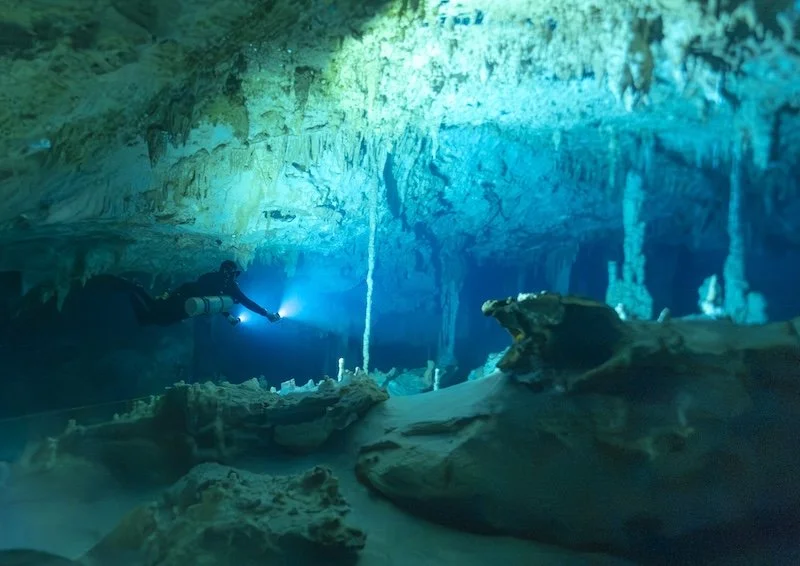
Ancient limestone formations inside one of Tulum's underwater cenote caverns.
Before the Cenotes: The Yucatán Peninsula Beneath the Sea
Long before Tulum's cenotes became the underwater landscapes we know today, much of the Yucatán Peninsula was part of an ancient marine environment.
Over millions of years, layers of carbonate sediments accumulated on the seafloor. These deposits, including material from marine organisms and ancient reef environments, eventually formed the limestone that makes up much of the peninsula.
Even today, marine fossils can be found embedded in some of these rocks, revealing their underwater origins.
As geological conditions and sea levels changed, parts of the peninsula emerged above the ocean, exposing the limestone to rainwater and the atmosphere.
And that's when another remarkable process began.
How Did the Underground Caves of Tulum Form?
The limestone beneath the Yucatán Peninsula is naturally porous and contains fractures through which water can move.
When rainwater absorbs carbon dioxide from the atmosphere and soil, it becomes mildly acidic. As this water infiltrates the ground, it slowly dissolves the limestone.
Over geological time, this chemical process enlarged natural fractures and helped create extensive networks of underground passages.
In the coastal areas of Tulum, the interaction between freshwater and saltwater also played an important role. Where these waters mix, chemical conditions can increase limestone dissolution, helping develop and enlarge cave passages. This process is explained in scientific research on cave development along the Caribbean coast of the Yucatán Peninsula
The ocean therefore influenced the formation of these cave systems, although not simply through waves or currents carving tunnels into the rock.
As sea levels rose and fell during past ice ages, groundwater levels and freshwater–saltwater mixing zones shifted, contributing to the development of caves at different depths.
These natural processes helped create the underground landscapes that divers explore in Tulum today.
For a more detailed explanation of cenote geology and history, visit our What Are Cenotes? Guide.
What Are Stalactites and Stalagmites?
Once some of these underground passages became air-filled, another geological process began decorating their interiors.
Mineral-rich water dripping through the limestone slowly deposited calcium carbonate, creating the beautiful cave formations we see today.
These mineral deposits are known as speleothems, and they appear in several different forms.
Stalactites: Growing From the Ceiling
Stalactites hang downward from cave ceilings.
As water drips through the limestone, small amounts of calcium carbonate are deposited. Over time, these deposits gradually grow into formations that can resemble icicles.
Some are very thin and delicate, while others become much larger.
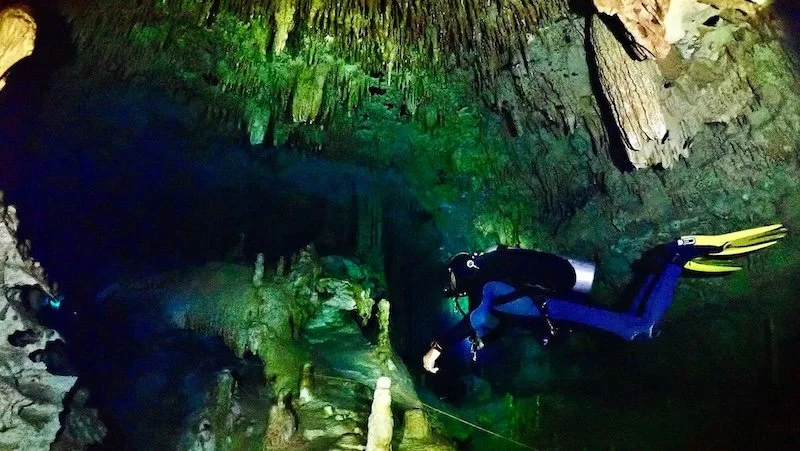
Stalactites formed by mineral-rich water dripping through the limestone ceiling.
Stalagmites: Growing From the Floor
Stalagmites grow upward from the cave floor.
They form when mineral-rich droplets fall from above and deposit calcium carbonate where they land.
Over long periods, these deposits build upward, sometimes forming impressive structures.
Columns: When Two Formations Meet
Sometimes a stalactite growing downward and a stalagmite growing upward eventually connect.
When this happens, they form a limestone column extending from the cave floor to the ceiling.
Some of the most impressive formations inside Tulum's cenotes are these ancient columns.
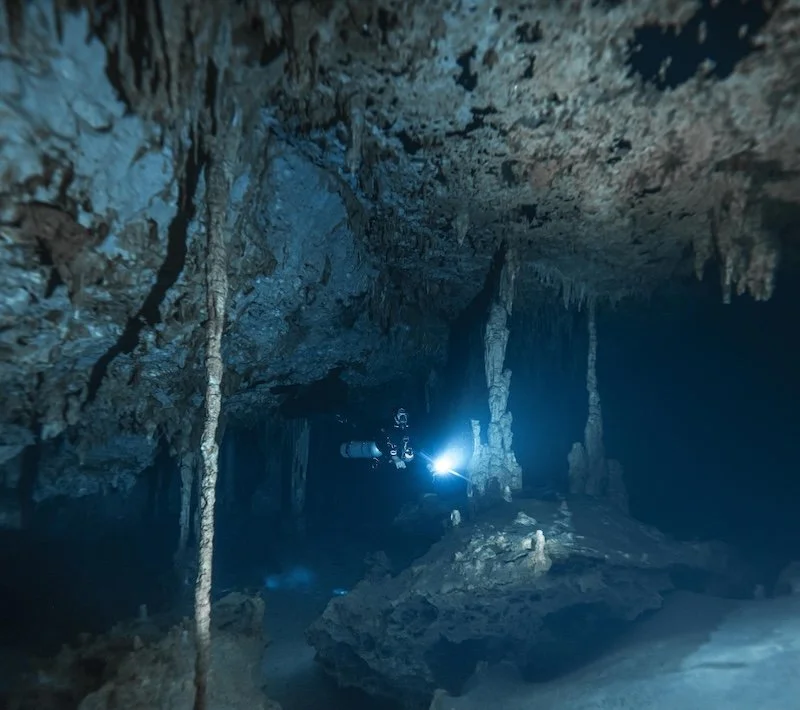
Stalagmites and limestone columns preserved inside an underwater cenote cavern.
Cave Curtains: Nature's Underwater Draperies
Another beautiful formation found in limestone caves is the cave curtain, also known as a drapery.
Unlike stalactites, which typically develop from dripping water, curtains form when mineral-rich water flows along sloping cave surfaces, gradually depositing thin, folded sheets of calcium carbonate.
Their shapes can resemble fabric hanging from the ceiling.
In some of Tulum's decorated caverns, these formations are among the most delicate features divers can observe.
Why Are These Ancient Formations Underwater Today?
This is one of the most fascinating parts of cenote diving.
Many of the stalactites, stalagmites, and columns we see underwater today originally developed in air-filled caves.
During past ice ages, large amounts of Earth's water were stored in glaciers, and global sea levels were considerably lower than today.
As the climate warmed and glaciers melted, sea levels gradually rose. Groundwater levels in the Yucatán Peninsula also changed, flooding many previously air-filled cave passages.
The limestone formations remained beneath the water, preserving evidence of an earlier environment.
When we dive through these caverns today, we're exploring ancient caves that were shaped, decorated, and eventually submerged over long periods of geological time.
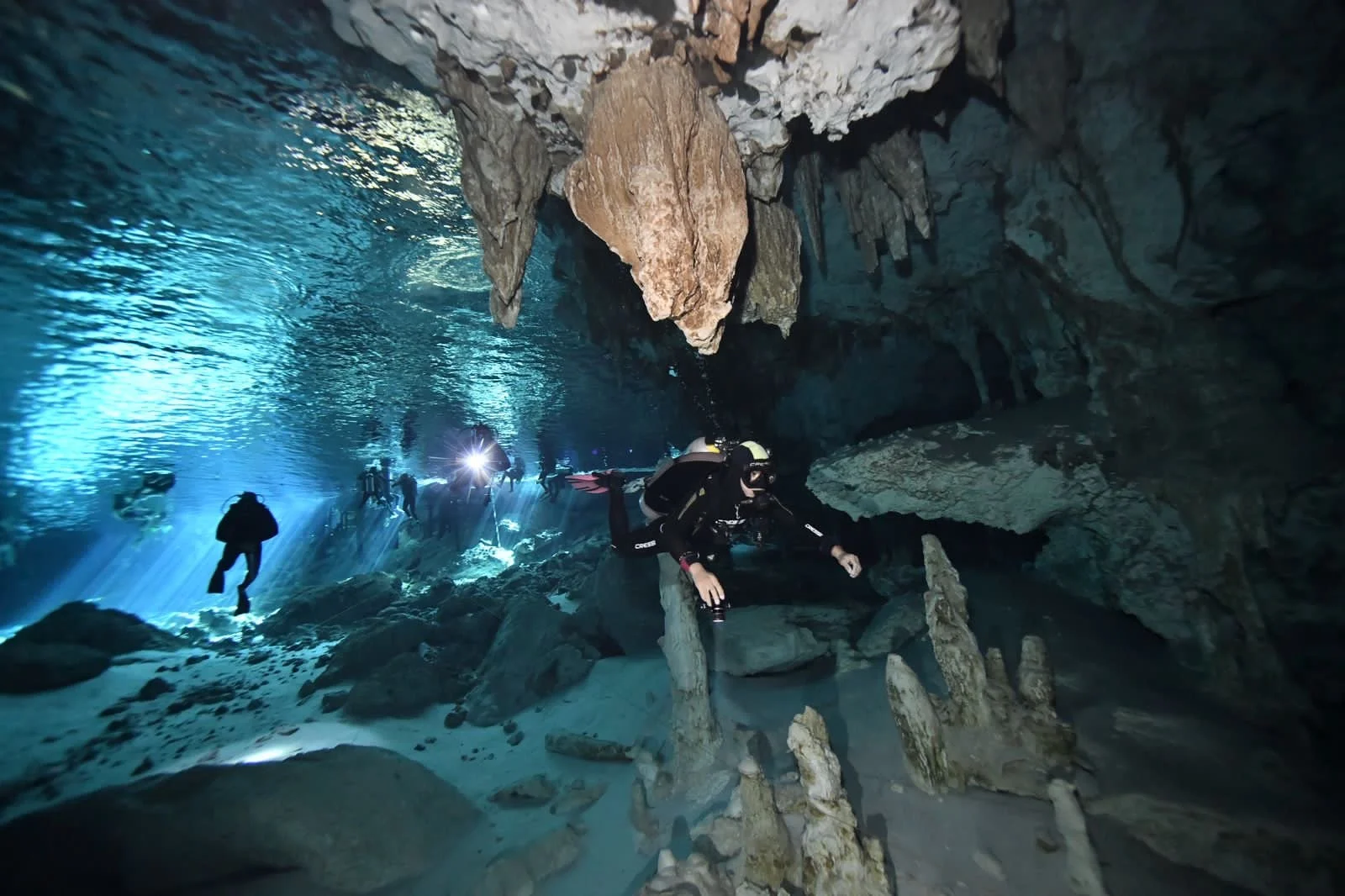
Ancient cave formations now submerged beneath the groundwater of the Yucatán Peninsula.
Where Can You See These Formations Around Tulum?
Not every cenote looks the same.
Some are open, sunlit environments surrounded by vegetation, while others contain extensive cavern passages decorated with stalactites, stalagmites, columns, and curtains.
Two of our favorite places to appreciate these formations are:
Cenote Dos Ojos
Dos Ojos is known for its beautiful cavern passages, clear water, and impressive limestone formations.
During the guided cavern dives, we can observe stalactites hanging from the ceiling, stalagmites rising from the floor, and ancient columns connecting the two.
The combination of natural light, clear water, and limestone formations makes Dos Ojos a memorable experience for certified divers.
Cenote Dreamgate
Dreamgate offers a different atmosphere.
Its cavern passages are richly decorated with delicate limestone formations, including numerous stalactites, stalagmites, and columns.
Because these formations are extremely fragile, excellent buoyancy control and careful diving techniques are especially important.
For divers who appreciate geology and underwater photography, Dreamgate is a remarkable place to explore.
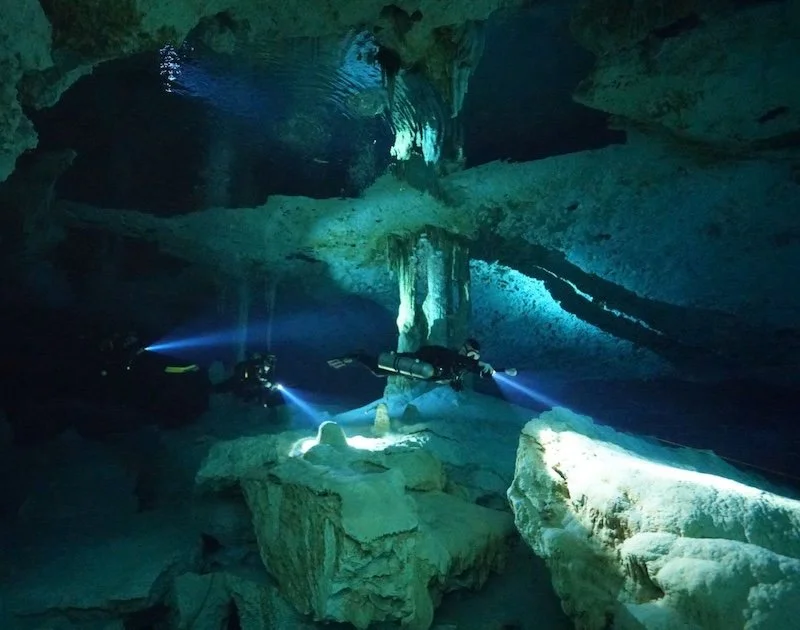
Delicate limestone formations inside one of Tulum's decorated cenote caverns.
Why Protecting These Formations Matters
One of the things we always remind divers is that these formations are incredibly fragile.
A stalactite that took thousands of years to develop can be damaged in just a moment by an accidental touch, a fin kick, or poorly controlled equipment.
That's why responsible cavern diving requires good buoyancy, careful finning techniques, and following established cavern routes with a properly qualified guide.
We never touch, collect, or disturb these formations, and we always maintain a respectful distance from the cavern walls, ceilings, and floors.
These underwater environments also preserve valuable geological and, in some places, archaeological information.
Protecting them means future generations can continue discovering the same remarkable landscapes.
Exploring the Ancient Underwater World of Tulum
After more than 20 years diving around Tulum, these cenotes still manage to surprise us.
Every cavern has its own character, its own formations, and its own geological story.
Sometimes it's the sunlight entering through an opening that catches our attention. Other times, it's a tiny stalactite, a delicate curtain, or a massive limestone column that reminds us just how much time nature has spent creating these places.
And that's one of the reasons cenote diving is so special.
We're not just exploring underwater caverns. We're witnessing a part of Earth's history preserved beneath the water.
If you'd like to discover more about these incredible environments, explore our Cenote Diving in Tulum experiences and learn about the different cenotes we visit.