
Complete Guide to Cenote Dos Ojos for Scuba Divers

Divers heading towards bat cave line
If you're planning a cenote diving trip in Tulum, Dos Ojos Cenote should be at the top of your list. One of the most iconic cenotes in Quintana Roo — and in all of Mexico — Cenote Dos Ojos offers two completely different dive experiences within the same system, each with its own atmosphere, rock formations, and cristal clear water.
This complete guide covers everything you need to know before you dive at Dos Ojos: the two lines, what to expect underwater, how much the entrance fee is, how to get there, tips for getting the most out of your visit, and practical information for planning your trip.
Quick Overview
Type of Dive: Cavern / Shallow
Location: 25 minutes from the dive shop
Depth: Max 10 meters / 30 feet
Certification Level Required: Open Water
Dive Time: 40- 45 minutes each line
Highlights: Stalactites, light beams, crystal clear waters, exit to another cenote
Dos Ojos Map
What Is Cavern Diving — And Is It Safe for Open Water Divers?
Before diving into what makes Dos Ojos so special, it's worth clarifying something that often causes confusion: the difference between cavern diving and cave diving.
Cavern diving takes place within the natural light zone — meaning you're always within sight of natural daylight and within a safe, guided distance of the open water. It does not require any specialized certification beyond Open Water, and it's the type of diving Mexidivers offers at Dos Ojos.
Cave diving, on the other hand, goes beyond the light zone into fully enclosed overhead environments and requires advanced technical training and specific cave diving certification.
So while our guides hold Full Cave Diver certification — which is required to legally and safely guide in cenote environments — you only need your Open Water certification to join us for a cavern dive at Dos Ojos. Our guides' training ensures the highest level of safety, route knowledge, and emergency preparedness so you can simply enjoy the experience.
Dos Ojos: The Dive System
"Dos Ojos" means "Two Eyes" in Spanish — named after the two circular openings in the jungle that look like a pair of eyes from above. These two sinkholes serve as entry points into one of the most extensive underwater cave systems in the world.
The Dos Ojos system is part of the larger Sac Actun cave network, which stretches for hundreds of kilometers beneath the Yucatán Peninsula. What you'll explore as a cavern diver is a small but breathtaking section of this ancient world.
the two Dive Lines
✳ Barbie Line
Length: 415m
Depth: 7m / 21ft
Dive Time: 40-45 minutes
Wide spaces and large light galleries.
The Barbie Line is the classic Dos Ojos experience and typically the first dive of the day. Wide, open passages filled with natural light filtering down from above, massive stalactite and stalagmite formations, and exceptional visibility that can reach 30 meters or more on a good day.This is one of the most visually stunning cavern dives in Tulum. The light galleries — areas where shafts of sunlight pierce the water and illuminate the formations below — are unlike anything you'll find anywhere else in the world. Don't forget to look up.
Best for: First-time cenote divers, underwater photography, wide open spaces.
✳ Bat Cave
Length: 300 m
Depth: 10m / 30ft
Dive Time: 40-45 minutes
Why Dive Cenote Dos Ojos?
The Bat Cave is a connected cenote reached via an underwater passage from Dos Ojos. The atmosphere here is completely different — darker, more enclosed, and more dramatic. The dive line passes through an air dome inside the cave, where your guide will signal you to surface.When you break the surface inside the dome, you're standing in a hidden chamber deep inside the jungle, surrounded by a living colony of bats clinging to the limestone ceiling above you. The sound of their movement echoes through the cave. It's one of those moments that's difficult to describe and impossible to forget.
Best for: Divers looking for a more adventurous, atmospheric experience after the Barbie Line.
What You'll See Underwater
Dos Ojos is a freshwater cenote, so the marine life here is different from what you'd encounter on a reef dive. What makes it extraordinary is the geology and the light.
Stalactites and stalagmites — formed over thousands of years when the caves were above water, these massive limestone formations fill the passages from floor to ceiling
Light beams — on sunny mornings especially, shafts of light cut through the water and illuminate the formations in a way that feels almost otherworldly
Small freshwater fish — endemic species adapted to the cenote environment
Ancient geology — the Yucatán Peninsula has no rivers above ground; the cenotes are the surface expression of a massive underground river system that has been forming for millions of years
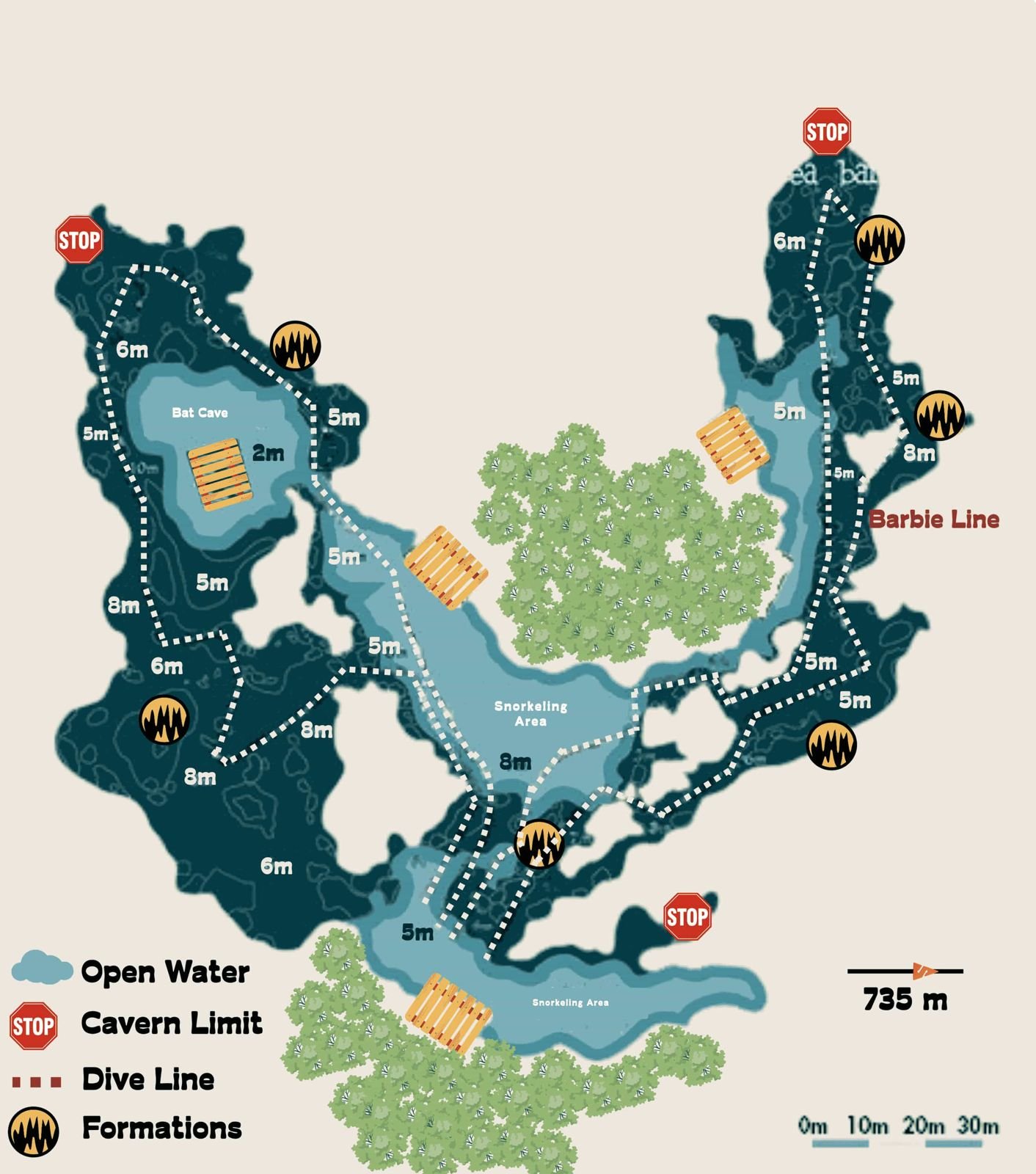
The map shows both entry points (the "two eyes"), the Barbie Line circuit, the underwater passage to the Bat Cave, and the air dome location inside the Bat Cave system.
Tips for diving Cenote Dos Ojos
Dive with a certified guide
Your cenote dive guide should be certified as a Full Cave Diver and have completed specialized cave training.Practice good buoyancy control
Dos Ojos has delicate formations and silty floors. Maintaining neutral buoyancy and using gentle finning techniques helps preserve visibility and protects the underwater environment.Make sure you’ve dived recently
For your safety and comfort, it's best if you've logged a dive within the last 12 months. If it’s been longer, a quick refresher dive beforehand is highly recommended.Bring cash
You’ll need it for the cenote entrance fee (if it’s not included in your dive package), and for small extras like snacks or souvenirs. Don’t miss Fish Eye — the on-site shop with unique Dos Ojos t-shirts and keepsakes.Consider afternoon dives
Most dive groups arrive early in the morning. Choosing an afternoon time slot often means fewer crowds, shorter waits, and a more peaceful atmosphere in and out of the water.6. Skip the sunscreen and bug spray
Both are harmful to the cenote ecosystem. Rinse off before entering the water. If you need sun or insect protection, opt for eco-friendly, reef-safe products and apply them after your dive.
Bring a towel and dry clothes
After your dive, the cool water and shaded environment can leave you feeling cold. A dry towel and change of clothes will make your post-dive time more comfortable.
How to Get to Cenote Dos Ojos
Cenote Dos Ojos is located on Carretera Federal 307, approximately 25 km south of Tulum town — about a 25-minute drive from the Tulum hotel zone.
By car or rental: Head south on Highway 307 from Tulum. Look for the Parque Dos Ojos sign on the right side of the road. There is a well-marked entrance and a parking area on site.
By taxi or colectivo: Colectivos run frequently along Highway 307 and can drop you near the entrance. A taxi from Tulum town typically costs around $200–300 MXN one way.
With Mexidivers: When you book a cenote diving tour with us, transportation from our shop at Tulum Beach is included. We handle pickup, logistics, and drop-off — you just show up ready to dive.
From Cancún: Dos Ojos is approximately 1.5–2 hours south of Cancún via Highway 307.
Practical Information
Full Name: Parque Dos Ojos, Quintana Roo, Mexico
Address: Carretera Federal 307, Km 124, Tulum, Q.R.
Hours: Daily 8:00 AM – 5:00 PM (last entry 3:00 PM)
Cenote Dos Ojos Price (Diving): $400 MXN (~$18–21 USD)
Entrance Fee (Snorkeling): $400 MXN (~$18–21 USD)
GoPro / Camera Fee: ~$300 MXN
Distance from Tulum: ~25 minutes by car

FAQs About Cenote Dos Ojos
How much does it cost to visit Cenote Dos Ojos?
Cenote Dos Ojos price is $400 MXN per person (~$18–21 USD), applicable to both scuba diving and snorkeling. Bringing a GoPro or underwater camera costs an additional ~$300 MXN. Note that this park entrance fee is separate from the cost of your diving tour with Mexidivers.
How do I get to Cenote Dos Ojos from Tulum?
Dos Ojos is located on Highway 307, about 60 km south of playa del carmen and 25 km north of Tulum — roughly a 25-minute drive. You can get there by rental car, taxi (~$200–300 MXN from Tulum town), or colectivo. If you book your cenote dive with Mexidivers, round-trip transportation from Tulum Beach is included.
Do I need to be certified to dive at Dos Ojos?
Yes. A minimum Open Water certification is required for cavern diving at Dos Ojos. Your guide must hold Full Cave Diver certification. If you're not yet certified, we offer PADI Open Water courses in Tulum that qualify you to dive here.
Can beginners dive at Dos Ojos?
Yes — Dos Ojos is considered one of the most beginner-friendly cenote dives in Tulum. The Barbie Line in particular is wide, well-lit, and relatively shallow (max 7 meters). As long as you have your Open Water certification and feel comfortable in the water, you're good to go.
How deep is Dos Ojos?
The Barbie Line has a maximum depth of 7 meters / 21 feet. The Bat Cave reaches a maximum of 10 meters / 30 feet.What are the operating hours?
Open daily from 8:00 AM to 5:00 PM, but last entry is at 3:00 PM — after that, no new visitors are allowed in.
Can I snorkel at Dos Ojos?
Absolutely. Non-divers are welcome to snorkel the open sections of the cenote. Snorkeling gear is available for rent on site, and guided snorkeling tours to areas like the Bat Cave air dome can also be arranged.
How long does a full visit take?
Plan for approximately 3–4 hours for two dives (Barbie Line + Bat Cave), including setup, briefing, surface intervals, and exit. A snorkeling-only visit is shorter.
What's the water temperature?
The freshwater at Dos Ojos stays at a consistent 24°C / 75°F year-round — refreshing, but cool enough that a 3mm wetsuit is recommended, especially for two dives back to back.
Is Dos Ojos open year-round?
Yes. One of the great things about cenote diving in Tulum is that conditions remain remarkably consistent throughout the year — no seasons, no storms affecting visibility, and the same water temperature every month.
What's the difference between the Barbie Line and the Bat Cave?
The Barbie Line is brighter, more open, and more visually dramatic — ideal for photography and first-time cenote divers. The Bat Cave is darker, more enclosed, and offers the unique experience of surfacing inside a bat colony air dome, both with crystal clear water Most visitors do both in a single trip.
Why Dive Dos Ojos with Mexidivers?
We've been diving the cenotes around Tulum for over 20 years. Our guides know the Dos Ojos system intimately — not just the route, but the best light conditions, the quieter moments in the day, and the small details that make a dive unforgettable.
We keep our groups small, our equipment maintained, and our approach grounded in respect for the environment. Every time we enter a cenote, we're guests in one of the most extraordinary ecosystems on the planet. We take that seriously.
Transportation from our shop at Tulum Beach is included in all cenote packages. We handle everything — you just show up ready to dive
Book YOur Adventure
Book your dos ojos diving trip today and discover why scuba diving in cenotes is one of the most magical experiences Mexico has to offer.